skip to main |
skip to sidebar
 I took over 500 shots during my last visit to
 YSP
.
The ones I like the most were taken inside the hive. They are dark and claustrophobic, ambiguous and a bit creepy.
I've put a few more images on my website too.

 A while ago i met a forensic entomologist (like you do)*, and he invited me to look at bees under the microscopes at the Uni near me in Preston. So yesterday i took along my little collection of dead bees that i've been gathering for a while.I entered a magical, mesmerising world inspecting these creatures in so much detail. The complexity of their eyes, the hair magnified, the breathtaking beauty of the wings and the individual grains of pollen collected on their legs. One of my dead bees had its sting out - in close up a gorgeous vicious weapon. I feel that i don't have the capacity of describing the visions in words.I tried unsuccessfully to take photos down the lens, but Adam mentioned they do have a camera that can capture the images and i can use it next time. Really can't wait for the next visit.* Forensic entomologist - someone who works with a highly trained team of insects to detect crime.
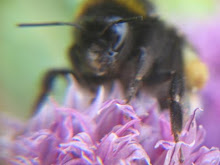
 I moved house a couple of days ago so i've not been thinking of bees (just how to try and fib to my friends that i haven't much heavy stuff to shift). I found another dead bee the other day in the park - a buff-tailed bumblebee. I've been offered the use of microscopes at the local university so i can study all the dead ones i've collected more closely (the image above is of a bee I collected last year and kept).
Also, quite a few people are sending things, giving me books and emailing links to things related to bees - my friend Rich sent this link to an article from Lancaster University:Lancaster University Newsand another friend William sent me this one too about a project 'Figures and Hives'

 While i've been looking for bees around the YSP site i've been counting plant species and also birds and butterflies too.
My friend Owen (a botanist) came to the sculpture park last week and as we wandered round we made a note of all the species. At some point I will list all the plants on the blog, but I move house in a couple of days and i've packed my notebook already. I know this blog is about bees, but I thought these two images were quite ok.
Top: Underside of Orange tip butterfly on Forgetmenot (a special flower)
Bottom: Peacock butterfly on blossom


 I found this bee at YSP and was excited as it looked unlike the others i've found so far. I took lots of shots and took a note of its markings then tried to find out from the key in my book what it might be.So, I decided it might be a Bombus sylvestris (Four-coloured Cuckoo-bee), but sent the images to a bee chap called Brian to see what he thought. This is his reply: "Right, I'm going with Bombus bohemicus (Gypsy Cuckoo-bee) which has lost tail hairs and now has a blank patch. This is cos in the first photo there are two pretty faint yellow stripes which sylvestris wouldn't have. Actually i'll go back to the start:
It's obviously a cuckoo cos of the yellow stripe at the top of the thorax and the white bum.
You can probably see the lack of corbiculum cos your photos are v. good.
There are two faint yellow stripes at the top of the abdomen on the first photo, suggesting vestalis or bohemicus. I've seen plenty of vestalis and the yellow stripes are loads bigger, so i'd hazard a guess at bohemicus.
The second photo shows the bum with no hairs, not black hairs (but i'm not sure from the Edwards and Jenner if sylvestris does have black hairs).I think that by counting the abdominal sections between pics 2 and 3 you can count 7, which would make it male, so a sylvestris would normally have a ginger tail (but this one has no hair, so that's no help!)
The book says sylvestris has its last abdominal section tightly curled around - i've no idea what that looks like, but thought i'd throw it into the mix.
(I've never seen a bohemicus, so either sylvestris or bohemicus would be really cool)"
He also suggested i send the images to BWARS - Bees, Wasps & Ants Recording Society, but i had trouble signing up to a Yahoo account to be able to put them on the forum - but i'll try again this week. And then we can perhaps confirm what the bee is.
As it goes, i'm still trying to see the yellow stripes - plus i had to look the word corbiculum* up before i could agree (which i don't know whether i do or not!)*In entomology, a smooth or concave space, fringed with stiff hairs, on the inner side of the tibia or basal joint of the tarsus of a bee. Clear now?
 I found another species for the site at YSP. It's a White-tailed Bumblebee Bombus lucorum. As it goes Sue (a gardener at YSP) mentioned she'd seen some already, but I saw my first one the other day on the Rhododendron flowers by the centre. The image isn't great, but you get a good view of its white tail.
Distribution: A common and very widespread species found in many habitats. but more frequent towards the north. A regular garden species. Nest-searching queens of this species are one of the first bumblebees seen in spring, as early as February in the south.
Nests: Made in a variety of situations, usually underground, but always under cover. Mature nests are large, often with over 200 workers.*
*Field Guide to Bumblebees Mike Edwards & Martin Jenner

 The bluebells are absolutely wonderful at the moment at YSP - in the woods on the nature reserve. The blue of the bells against the fresh green of the beech trees is such a beautiful sight.
I've seen quite a lot of Buff-tailed Bumblebees on the bluebells and also a number of Common Carder-bees.
The description of Common Carder-bee Bombus pascuorum (pictured above) in my Field Guide to Bumblebees (Mike Edwards & Martin Jenner) is this:
Distribution and biology - A widespread species found in many habitats. A regular garden species. The range of this species is expanding at the moment. Nest-searching queens are the earliest of the carder-bees to be seen, often in March in the south.
Nests - Made in a variety of situations but usually on or just under the ground. The bees collect moss to build the cover for the nests (hence carder-bee). Mature nests are medium sized, with about 100 workers.
Flower visits - Although this species will visit a fairly wide range of flowers it is very fond of the flowers of legumes and Dead-nettles. It is one of two common species which generally visits the flowers of Foxgloves (the other being B.hortorum)

 It was the Bee Project event day on Monday at YSP.
There were tours from the centre down to the project base at the boathouse and there was also a workshop (run by artists Kate and Bozz) to build bee boxes for your garden, a theatre company held performances and there was also a performance by the Nottingham Youth Voices and East Midlands Youth String Orchestra.I was joined on my tours by Thom and Saskia from YSP to talk about the history of the site and also about the sculptures on the grounds; plus my friends Owen (a botanist) and Steve (an arboriculturalist) came with us all to point out plants and trees on our route to the boathouse.
The weather wasn't great - we went through rain and hail, but finally got some sunshine too - so when we got down to the boathouse Ivor (the apiarist) could show us into the new hives.
Thanks to everyone who came to YSP on Monday - especially everyone on my two tours.Top image by Gavin Renshaw
Bottom image by Steve Canham
 In my quest to get good photos of bees I spent ages crawling about on my knees following a bumblebee as it circled and hummed about a particular patch of ground. It then went under a leaf and stopped moving. So i waited - and waited for it to come out from under the leaf. And waited.
I could hear faint buzzing though... and wondered where it might be. So i moved the leaf only to reveal a hole that the bee had disappeared down. As it goes it came out of another entrance and got away without me getting a photo of it.
So, here is an image of a bee hole!
 My friend sent a text last night to say the Bee Project Open Day event at YSP is mentioned in the Sunday Times Travel section as one of the things to do on May 3rd bank holiday Monday. Cool.
On the open day I'm giving 2 tours down to the project base at the boathouse - which is not usually open to the general public - and I'll be joined by Ivor Flatman who is the apiarist looking after the YSP bees. Sunday TimesYSPThe image is from my trip to Japan - in Hiroshima
 There is a big patch of daffodils on the sloping lawn under the mansion house towards the lake at YSP and bees seem to love feeding amongst them. I saw this one for the first time there - I think it's Bombus hypnorum Tree bumblebee and the description in my field guide is this:
"Distribution and biology: Newly found in the UK in 2000; this species has been expanding its range steadily in mainland Europe and is now doing so in the UK. It seems to have a close affinity with urban and woodland habitats throughout Europe, where it is widely distributed. This species is double-brooded, with nests-searching queens in march and again in June. New females appear from the end of May to September."

 Last week while at YSP i saw masses of bees - lots of Buff-tailed Bumblebees Bombus terestris, and this time I saw quite a lot of honey bees too feeding on the willow catkins. I also saw a couple of Red-tailed Bumblebees Bombus lapidarius (the images here aren't great but you get to see how glossy velvet it is and the red tail - interestingly i think some of the small pale dots on it might be mites perhaps - they can be seen a bit clearer on the high res photos). The description in my field guide* says this:
"Distribution: A widespread species found in many habitats. It is currently spreading into north-eastern Scotland.
Nests: Made in a variety of situations, usually in open areas; underground or in wall cavities. Nest-searching queens can be seen from March to June, depending on the distance north. Mature nests are large and frequently contain 150 workers. Young nests are sometimes taken over by the similarly coloured social parasitic species B. repestris. Males are often seen patrolling round isolated bushes or along hedge lines. Newly mated queens may hibernate in large numbers in traditional areas, such as north-facing banks in open woodland."
*The Field Guide to Bumblebees of GB and Ireland by Mike Edwards and Martin Jenner (i love this book)